
Your Giant Teddy Bear Isn't Selling Your House. Neither Is Your Corvette.
Why decluttering isn't staging - and why the difference matters when selling your home.
I look at a lot of real estate listings. A LOT.
And every so often, I come across a photograph that makes me stop scrolling. Unfortunately, not always for the right reasons.
Recently, I've encountered a human-sized teddy bear occupying prime real estate on an adult bed. A children's sleeping tent that was undoubtedly magical for its young occupant but made it almost impossible to see the bedroom. A swimming pool surrounded by so many plants and trailing vines that I wondered whether the house came with it's own live-in gardener.
And then there was the bright red Corvette. Parked diagonally across the driveway, apparently positioned for maximum photographic impact.
Now unless the Corvette conveys with the property, I'm not entire sure what we're selling here.
Don't get me wrong. I love a home with personality. I love greenery. I have children, so I completely understand the necessity of a bedroom tent. And I know that giant teddy bear is loved.
But there's a difference between living in a home and marketing one for sale. And that difference is called Staging.
DECLUTTERING IS NOT STAGING
When homeowners are preparing to sell, they're often told to tidy up, put away personal belongings, and make sure the house is clean before the photographer arrives. All perfectly sensible advice. But that's just the beginning.
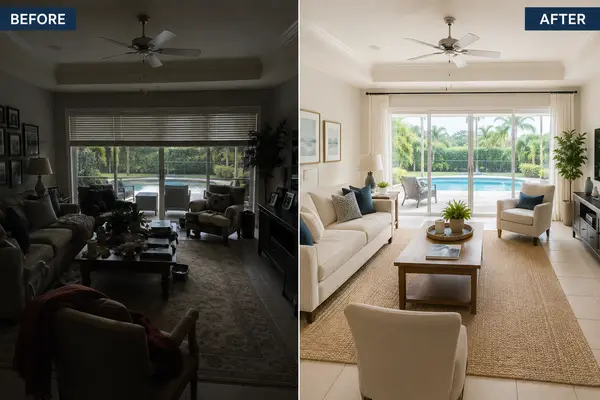
Decluttering removes things. Staging makes deliberate decisions about what stays, what goes, and where items should be placed to maximize impact and minimize distraction.
It's about understanding how buyers perceive space, light, proportions, functionality and flow.
A room can be spotlessly clean, beautifully decorated, and still photograph terribly. Equally, a room doesn't need expensive furniture and a complete makeover to look wonderful in photographs.
Sometimes the difference is as simple as removing an oversized chair, repositioning a bed, taking down heavy curtains, or clearing the view so buyers can see the sparkling pool outside the windows.
Other times, it means addressing the way furniture is arranged. A beautiful sectional sofa might be perfectly comfortable for family movie nights, but if it takes up the whole living room, it can make the space feel smaller and less functional.
The same applies to oversized dining tables, crowded bookshelves, heavy window treatments, counterspace covered with small kitchen appliances, and bedrooms containing more furniture than the space can comfortably accommodate.
The objective isn't to photograph how you live. It's to help buyers imagine how they could live.
And that requires more thought than simply putting things away.
YOUR FAVORITE THINGS AREN'T NECESSARILY SELLING FEATURES
Let's return to our teddy bear. It's adorable. He may have been a treasured family companion for years. But if he's the first, or only, thing a buyer notices in the photograph, he's competing with the room itself. And Teddy isn't coming with the house.
The sleeping tent might be a child's dream, but if it obscures the bed, windows, and proportions of the room, buyers are missing the information the photograph is trying to provide.
And plants? Everyone knows how much I love plants! A few thoughtfully positioned plants can add life to a cold house and soften a room. But when every lanai post is wrapped with vines and dozens of potted plants cover every surface of the outdoor area, they compete for attention with the gorgeous pool, which is one of the home's greatest assets.
The same principle applies to furniture, artwork, collections and decorative accessories. I'm not suggesting that a home should be stripped of personality and transformed into a sterile, all-white showroom. Quite the opposite. A thoughtfully presented home should feel welcoming, inviting and comfortable.
But if buyers remember your possessions more clearly than your property, something has gone wrong.
STAGING ISN'T ABOUT SPENDING A FORTUNE
One of the biggest misconceptions about home staging is that it requires hiring a professional stager, renting expensive furniture, or completely redecorating.
Sometimes those things make sense, particularly for vacant properties or homes where the existing furnishings don't complement the architecture. But many occupied homes can be dramatically improved using what the homeowner already owns.
I've walked through properties where removing a few pieces of furniture would have made an enormous difference. A room that feels cramped suddenly feels spacious. A beautiful window that was previously obscured suddenly lets in the light.
Good staging isn't necessarily about adding more. Quite often it's about knowing what to take away.
The goal is to draw attention to the property's strengths while minimizing unnecessary distractions - highlighting the fireplace, opening up the view, improving the flow between rooms, helping buyers understand how an awkward space might function.
Sometimes it can mean making small, inexpensive improvements prior to photography. Fresh bedding. Better lighting. Neutral towels. None of these require a substantial investment.
DECORATING IS PERSONAL. STAGING HELPS BUYERS SEE A PROPERTY'S POTENTIAL.
When we decorate our homes, we make choices based on our tastes, our lifestyle, and the things that make us happy. Perhaps you love bold colors, antique furniture or walls filled with sports memorabilia.
Wonderful! It's YOUR home. But when you decide to sell, your property becomes a product competing for attention in a market filled with other properties.
That doesn't mean stripping it of every trace of individuality, but presenting it in a way that appeals to the broadest audience while highlighting features that make it special.
BUT ISN'T THAT THE REAL ESTATE AGENT'S JOB?
Yes, absolutely. Homeowners shouldn't be expected to understand the finer points of staging, buyer psychology, or how to prepare a property for professional photography. That's why they hire a professional!
And yet, having a real estate license doesn't automatically make someone an expert in staging, photography, design or marketing.
Some agents have excellent instincts. Others may rely on a team of talented stagers, designers, and photographers.
But just telling a homeowner to 'tidy up' and then scheduling a photographer isn't a marketing strategy. It's an appointment.
A good real estate professional should be able to walk through a property and identify what will help it sell - and what might get in the way. That includes being willing to have honest conversations with homeowners.
It's easy to compliment a homeowner on their beautiful home. It's a little harder to explain that some of those things need to be moved, rearranged, or temporarily stored offsite before the house goes on the market.
That advice should be handled thoughtfully and respectfully. The objective isn't to criticize their taste. But if politely asking the homeowner to move the flashy red Corvette ultimately helps them achieve the best possible outcome when they sell, the conversation needs to be had.
ONE FINAL THOUGHT
Selling a home involves a transition. For years, perhaps decades, the property has been your personal space. It's where you've raised children, celebrated holidays, entertained friends, and accumulated the things that make a house feel like a home.
Those memories are precious. But when you decide to sell, the objective changes.
You're no longer presenting the property for yourself. You're presenting it for its next loving owner.
And helping buyers imagine themselves living there is one of the most important things you can do.
Your home doesn't need to look like nobody lives there. It needs to look like somebody else could.
So keep the teddy bear. Enjoy the jungle of plants. Let the kids play in their wonderful bedroom. And take the red Corvette out for a spin.
Just not on photography day!

LEAVE A REPLY
